
smile-design
How to Build a Full Smile Makeover Plan That Works
Full smile makeover plan explained: how to properly sequence Invisalign, whitening, and veneers together for the best result.
Sep 22, 20266 min read



Not everyone actually needs their wisdom teeth taken out, despite how often wisdom teeth removal gets treated as an automatic rite of passage. Whether extraction makes sense depends on real clinical criteria: how the teeth are positioned, whether they're causing crowding or infection, and how much room your jaw actually has. This guide walks through when removal is genuinely necessary, what an impacted wisdom tooth actually means, and who handles the procedure when it's needed. Wisdom teeth get evaluated as part of a routine general dentistry exam, well before removal is ever recommended.
Wondering About Your Wisdom Teeth?
An exam and X-rays can tell you exactly where things stand, whether that means monitoring or a referral for removal.
Book Appointment →No, not every wisdom tooth needs to come out. Removal is genuinely necessary when a wisdom tooth is impacted, causing crowding, decayed beyond repair, or contributing to infection. A fully erupted, properly positioned wisdom tooth that you can clean effectively can often stay in place.
The "everyone needs it" assumption comes from the fact that most people's jaws simply don't have enough room for a third set of molars, so problems are common but not universal. Dr. Curley evaluates each wisdom tooth individually using an exam and X-rays, looking at its angle, how much of it has emerged, and whether it's affecting the teeth next to it before recommending anything. Some patients have all four wisdom teeth removed while others need only one, and a small share need none at all. There's no single rule that applies to every mouth.
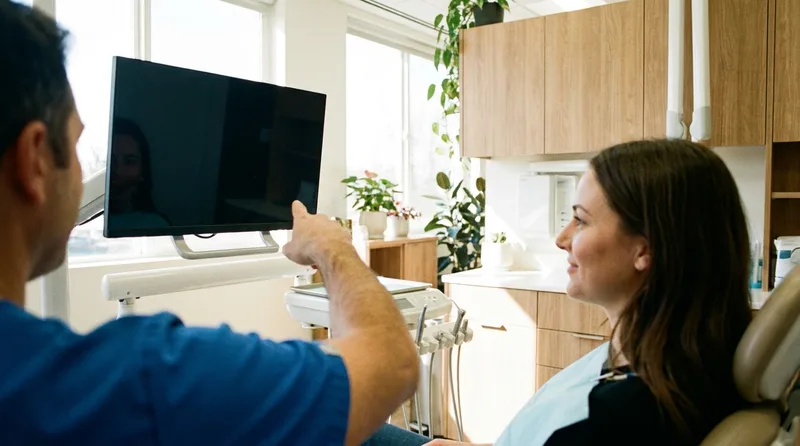
If your wisdom teeth are positioned well and not causing any of these issues, monitoring at your regular checkups may be all that's needed, sometimes indefinitely. Removing a tooth that isn't causing a problem simply to avoid a hypothetical future issue is not standard practice here; the recommendation follows what the exam and X-rays actually show.
An impacted wisdom tooth is one that doesn't have enough room to fully emerge through the gum, either staying partially or fully trapped beneath the surface. Impaction is the single biggest reason wisdom teeth end up needing removal.
| Impaction Type | Description |
|---|---|
| Soft tissue impaction | Tooth is covered by gum tissue but otherwise upright |
| Partial bony impaction | Tooth is partially covered by jawbone |
| Full bony impaction | Tooth is entirely encased in jawbone |
| Angled impaction | Tooth is tilted toward or away from neighboring teeth |
Each type carries a different level of complexity for removal. A soft tissue impaction is usually the most straightforward, while a fully bony or angled impaction typically needs a more involved surgical approach and, often, a specialist. X-rays are what reveal the impaction type in the first place, since a partially or fully bony impaction often isn't visible just by looking in the mouth.
Swelling near the back of the jaw, discomfort when chewing, and a bad taste or odor from the back of the mouth are signs your wisdom teeth need attention. Crowding of your other teeth can also signal a wisdom tooth pushing where it shouldn't.
Several of these symptoms can also point to something unrelated to wisdom teeth entirely, like a cavity or gum inflammation elsewhere, which is exactly why an exam rather than a guess is the right next step.
None of these symptoms guarantee removal is necessary, but they're worth a same-week exam rather than waiting for your next routine cleaning. A symptom that comes and goes over several weeks is just as worth checking as one that's constant, since intermittent irritation is still a sign something isn't sitting quite right. Waiting to see if it resolves on its own is one of the most common reasons a manageable issue turns into a more involved one.
Yes, wisdom teeth can stay in permanently if they're fully erupted, properly aligned, and easy to keep clean. Many adults keep all four wisdom teeth their whole lives without a single issue.
What matters is position and access, not the fact that they're wisdom teeth specifically. A tooth that has fully come in, sits at a normal angle, and can be reached with a toothbrush and floss carries roughly the same risk as any other molar. The problem cases are the ones that are angled, partially trapped, or hard to clean, since those create pockets where bacteria and food debris accumulate. Genetics play a role here too. Some people simply have larger jaws with more room for a full set of molars, while others inherit a smaller jaw that leaves little space for anything past the second molar.
Regular checkups are how Dr. Curley tracks whether a wisdom tooth that's currently fine stays that way, since position and risk can shift slightly over the years.
Considering Tooth Replacement Down the Road?
If a tooth removal ever leads to a gap that needs filling, our guide walks through the full implant process from start to finish.
Read the Implant Process Guide →An untreated impacted wisdom tooth can lead to infection, cyst formation, damage to the neighboring molar, and crowding of the surrounding teeth. The risk generally increases the longer an impacted tooth is left in place.
Bacteria can collect around a partially erupted tooth in a spot that's nearly impossible to clean properly, creating a chronic low-level infection risk. Over time, pressure from an impacted tooth can also damage the root or crown of the molar next to it, sometimes compromising a perfectly healthy tooth in the process. Regular dental visits catch roughly 80% of oral health issues before they become serious, according to the ADA, and an impacted wisdom tooth is exactly the kind of issue that benefits from being caught early.
None of this means every impacted tooth is an emergency, but it does mean monitoring matters and delaying an already-recommended removal rarely improves the outcome. A wisdom tooth that was manageable a year ago can shift into a more urgent situation as decay, crowding, or infection progresses, which is exactly why the recommendation gets revisited at each checkup rather than decided once and forgotten.
Straightforward wisdom tooth extractions may be handled during a routine visit, while impacted or surgically complex cases are typically referred to an oral surgeon. Dr. Curley makes that determination after the initial exam and X-rays.
This split exists because impacted teeth, especially those fully or partially encased in bone, require a level of surgical expertise and sedation options that go beyond a standard dental visit. It mirrors how surgical implant placement at this practice is also referred to a specialist, while the restorative side of care stays in-house. You'll know exactly which path applies to your situation before any appointment is scheduled, and Dr. Curley coordinates the referral directly rather than leaving you to find a surgeon on your own.
Either way, the evaluation and ongoing monitoring happen here, so you're never left guessing about what your specific wisdom teeth actually need. If a referral is the right path, Dr. Curley shares the exam findings and X-rays directly with the surgeon, so you're not repeating the same explanation at a second office.
Recovery from wisdom teeth removal typically takes several days to a week for simple extractions, and slightly longer for surgical or impacted cases. Swelling and soreness are most noticeable in the first 48 to 72 hours.

Most patients are back to normal activities within a week, though full healing of the gum and bone tissue continues quietly in the background for several weeks afterward. Whether removal happens here or with a referred surgeon, aftercare instructions are reviewed in detail before you leave so there's no confusion about what to expect over the following days.
Wisdom teeth are typically evaluated starting in the late teens, when they usually begin to emerge, though X-rays can sometimes reveal impaction risk even earlier. Waiting until symptoms appear is not the ideal strategy.
Roots are less developed and bone is generally softer at a younger age, which is part of why earlier evaluation, even before symptoms show up, tends to make removal simpler when it is genuinely needed. Waiting until the late twenties or thirties, when roots are fully formed and bone is denser, generally means a longer and more involved procedure if removal ends up being necessary. Americans who visit a dentist regularly are 60% less likely to lose teeth altogether, according to the Journal of Dental Research, which is part of the broader case for routine evaluation rather than waiting for a problem to surface on its own. According to MouthHealthy, the ADA's patient education resource, routine dental X-rays are the most reliable way to catch a developing impaction before it causes a noticeable problem.
If you're an adult who has never had your wisdom teeth evaluated, it's not too late to start. An exam and X-rays give Dr. Curley everything needed to tell you where things currently stand.
Wisdom teeth removal is not a default step everyone eventually needs, but it is the right call for a meaningful share of impacted or poorly positioned teeth, and the real clinical criteria, not tradition, should drive that decision. CDC oral health data consistently shows that catching dental issues early, wisdom teeth included, leads to simpler treatment and better outcomes than waiting for a problem to announce itself.
Results may vary. Please consult with your dentist at Susan J. Curley DDS for personalized treatment recommendations.
If it's been a while since your wisdom teeth were last checked, or you've never had them evaluated at all, the next step is a straightforward exam, not a guess about whether removal is coming.
Ready to Find Out Where You Stand?
Book an evaluation with Susan J. Curley DDS and get a clear answer on your wisdom teeth, backed by an exam and X-rays.
Book an Appointment →Prefer to talk it through first?
Call 732-681-8604 →Written By
Dentist
Full smile makeover plan explained: how to properly sequence Invisalign, whitening, and veneers together for the best result.
Digital smile design mockup explained honestly for patients: how it is created, why it is trustworthy, and what it shows you.
Smile design for a gummy smile: what actually causes it and which treatment options can genuinely help you feel confident.
Book your visit with Dr. Curley online or call us, and we'll take it from there.