Preventive Dentistry
How Often Do You Need Dental X-Rays? The Real Answer
How often do you need dental x rays? Dr. Curley explains actual radiation exposure, real intervals, and when yearly x-rays make sense.
Jul 15, 20268 min read


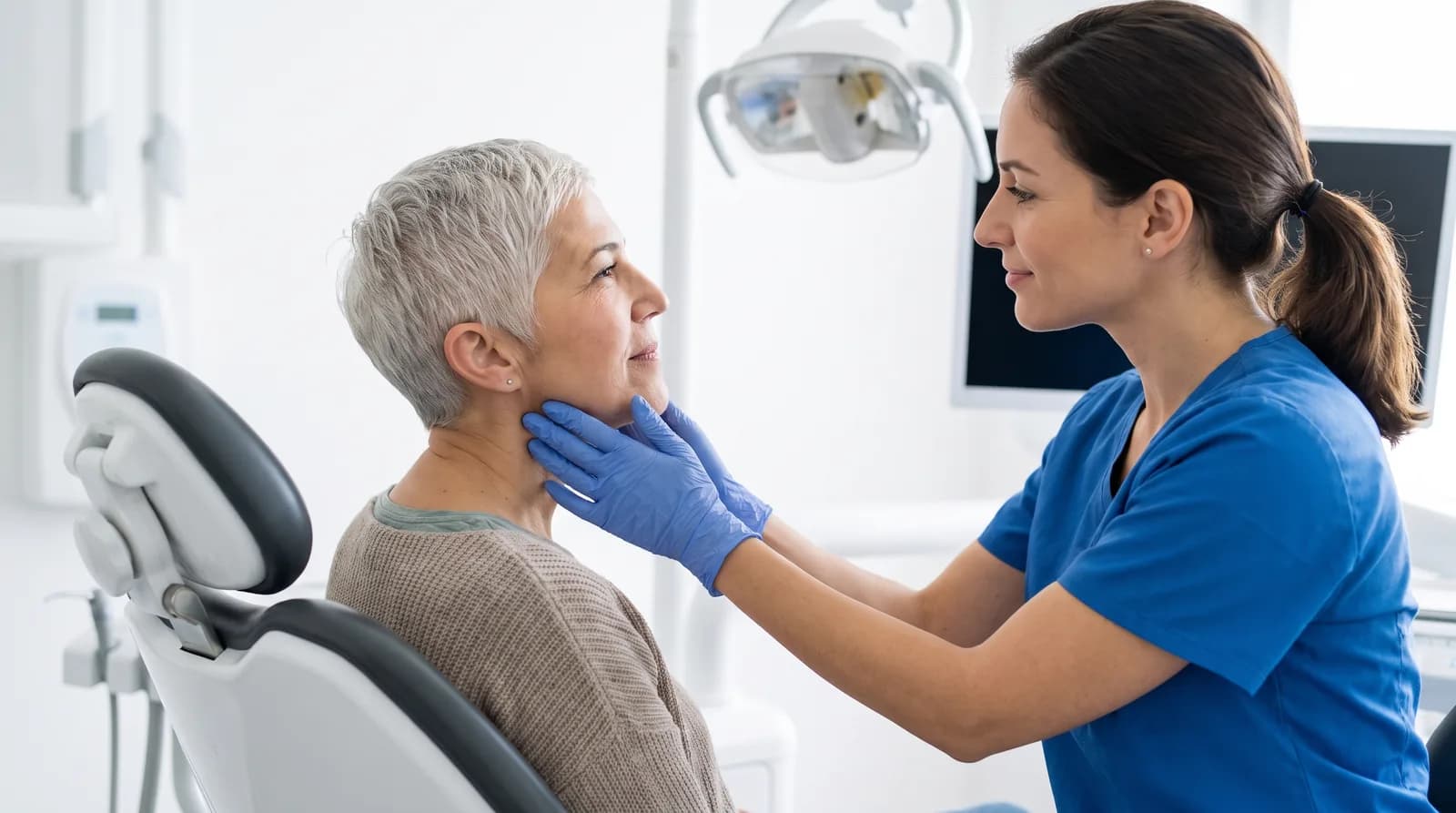
An oral cancer screening dentist visit is quick, painless, and already part of every checkup you've had, whether or not anyone specifically pointed it out to you before. There's no separate appointment to book and nothing extra to prepare for. It's simply built into the exam your dentist already performs, quietly happening in the background of a visit that's mostly focused on cleanings and cavity checks.
If the phrase "cancer screening" sounds intimidating, that reaction makes sense, but the reality is far less dramatic. This guide walks through what your dentist checks, how long it takes, and what happens if something unusual turns up. You'll also learn who's at higher risk and why dentists specifically are so well positioned to catch this early. Here at Susan J. Curley DDS, this screening happens at every checkup as a standard part of your care.
During an oral cancer screening, your dentist visually examines your lips, cheeks, gums, tongue, and the floor and roof of your mouth, then gently feels your jaw and neck for anything unusual. The entire process typically takes just a couple of minutes and happens during your regular exam, not as a separate step.
Your dentist is looking for specific things: sores that haven't healed, red or white patches, unusual lumps, or areas that look or feel different from the surrounding tissue. Dentists also check the tongue from both the front and back, the area where the tongue meets the floor of the mouth, the throat, and the tonsils. According to ADA MouthHealthy, these spots can be harder for patients to inspect themselves at home.
Checking your jaw and neck might seem unrelated to your mouth. Oral cancers can sometimes cause swelling in nearby lymph nodes before any visible change appears inside the mouth itself. Feeling for lumps or unusual swelling gives your dentist another way to catch something early, even if nothing looks different on the surface yet.
An oral cancer screening adds only a couple of minutes to your regular dental checkup, since it's performed alongside the visual exam your dentist already does at every visit. There's no additional wait time, no separate room, and nothing extra required from you.
This is part of why the screening rarely gets mentioned by name. It blends seamlessly into the exam, which is exactly the point. Regular dental visits can catch 80% of oral health issues before they become serious, according to the ADA. Oral cancer screening is one of the specific checks folded into that same routine visit.
Because it happens so quickly and quietly, some patients go years without realizing screening is even part of their checkup. If you've ever wondered why your dentist checks your neck or asks you to stick out your tongue during a routine cleaning, this is exactly what that's for. Nothing about the process changes based on whether you ask about it directly; it happens the same way for every patient at every visit.
| Area Checked | What's Being Looked For |
|---|---|
| Lips and cheeks | Sores, discoloration, unusual texture changes |
| Tongue (top, sides, underneath) | Red or white patches, lumps, persistent sores |
| Floor and roof of mouth | Swelling, unusual coloring, texture changes |
| Throat and tonsils | Visible irregularities, asymmetry |
| Jaw and neck | Lumps or swelling in lymph nodes |
If your dentist notices something unusual during screening, it doesn't mean you have cancer. Most findings turn out to be harmless, and your dentist's first step is usually to simply monitor the area and recheck it at a follow-up visit in a couple of weeks.
A review of nine screening studies covering more than 13 million patients found suspicious lesions in a small share of cases, with confirmed malignancies far less common still, according to a study published on PMC. That's a helpful reminder that a follow-up recommendation is far more likely to end in reassurance than in a serious diagnosis.
Many minor sores and irritations resolve on their own within that window, since they're often caused by something as simple as biting your cheek or a temporary irritation from something you ate. If an area doesn't heal or looks concerning enough to warrant a closer look right away, your dentist may refer you to a specialist for further evaluation, such as a biopsy. That referral is a precaution, not a diagnosis, and it's a normal part of thorough care rather than a sign something is seriously wrong.
It's worth knowing that even a biopsy referral is a routine diagnostic step, not an emergency. Biopsies are a standard way to get a definitive answer about tissue that looks unusual, and most biopsies for suspicious-looking spots come back benign. The referral is simply about getting certainty rather than guessing based on appearance alone.
Nervous about what your dentist might find?
If dental visits make you anxious for any reason, our team focuses on judgment-free, patient-first care at every appointment.
Read Our Dental Anxiety Tips →Tobacco use, heavy alcohol consumption, and certain strains of HPV are the most significant risk factors for oral cancer, according to the ADA's oral cancer guideline. Sun exposure specifically raises the risk of lip cancer, since lips are exposed skin like anywhere else on the body.
Combining tobacco and heavy alcohol use raises risk further than either factor alone, since the two compound each other's effects on oral tissue.
That said, oral cancer can affect people without any of these risk factors too, which is exactly why screening happens for every patient rather than being reserved for those in higher-risk categories. If you do smoke, drink heavily, or have other risk factors, it's worth mentioning to your dentist so they can pay closer attention to areas that tend to be more affected in higher-risk patients.
Age also plays a role, since oral cancer becomes more common as people get older, though it's not exclusive to any age group. The routine nature of the check means everyone gets the same baseline attention, regardless of personal risk profile. This consistency is part of what makes catching early cases possible even in patients who wouldn't otherwise be flagged as high-risk. It's preventive care working as intended: quietly, consistently, for everyone.
You can do a basic self-check between dental visits, though it's meant to complement professional screening, not replace it. Use a mirror in good lighting to look at your lips, gums, and the inside of your cheeks, and gently feel along your jaw and neck for anything unusual.
The goal of a self-check isn't to diagnose anything yourself. It's to notice something worth mentioning sooner rather than waiting six months or a year for your next scheduled checkup. Numbness, difficulty swallowing, a persistent hoarse voice, or a sore that hasn't healed after two weeks are all worth calling your dentist about right away.
Dentists check for oral cancer because they see the inside of your mouth more regularly and more closely than almost any other healthcare provider, including your primary care doctor. Most people see a dentist twice a year but may go years between full physicals that include a detailed look inside the mouth.
This regular, close-up access makes dentists uniquely positioned to notice small changes over time; a new white patch, a sore that wasn't there six months ago, unusual swelling. Dental checkups matter for more than cavities and cleanings. A visit that seems purely preventive is also doing quiet surveillance work, catching something serious early when treatment tends to be simpler and outcomes better.
This is also why keeping a consistent schedule with the same dentist has real value beyond convenience alone. A dentist who has seen your mouth every six months for several years is far better positioned to notice a subtle change than one seeing you for the first time. Continuity of care isn't just about comfort or familiarity, it's a practical advantage when it comes to catching something small before it becomes something significant.
Results may vary. Please consult with your dentist at Susan J. Curley DDS for personalized treatment recommendations.
Due for your next checkup?
Oral cancer screening is already built into every visit with Dr. Curley, alongside your regular cleaning and exam.
Book an Appointment →Written By
Dentist
How often do you need dental x rays? Dr. Curley explains actual radiation exposure, real intervals, and when yearly x-rays make sense.
Signs of gum disease often get dismissed as normal. Dr. Curley breaks down 5 early warning signs and what to do if you notice them.
How often should you get teeth cleaned? Dr. Curley explains why the 6-month rule isn't one-size-fits-all and what really sets your interval.
Book your visit with Dr. Curley online or call us, and we'll take it from there.