Periodontal Care
Gum Disease Treatment Stages: Gingivitis to Periodontitis
Gum disease treatment stages, explained from gingivitis through advanced periodontitis, so you know exactly where you stand and what treatment fits.
Jul 30, 20269 min read


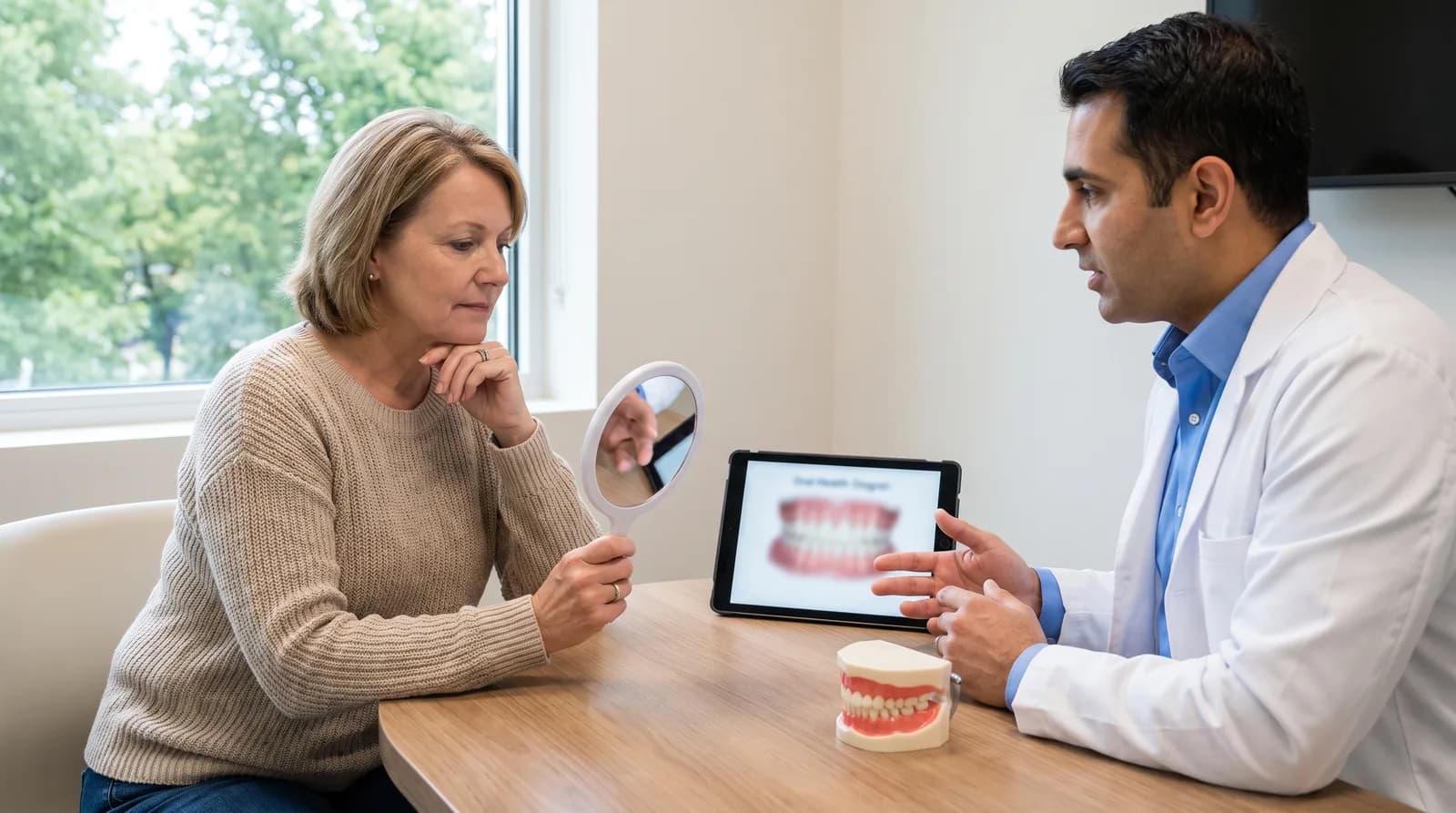
Noticing more of your tooth than usual, or new sensitivity to cold, often leads to the same worried question: are these gum recession treatment options going to mean surgery? Not necessarily. Recession covers a wide range, from barely noticeable to significant, and the right approach depends entirely on where you fall on that range. Our periodontal treatment team at Susan J. Curley DDS walks through exactly that below.
If gum disease is part of what's driving your recession, our guides on gum disease treatment stages and scaling and root planing cover that side of things in more depth. This guide focuses specifically on the recession itself: what causes it, and what treatment actually looks like at each level of severity.
The word "permanent" tends to be the scariest part of any conversation about gum recession. It's true that receded tissue doesn't grow back on its own, but that fact alone doesn't mean surgery is inevitable. Plenty of cases stabilize with simple changes, and understanding where your case likely falls removes most of the anxiety around the word, especially once you know what the actual measurement shows rather than assuming the worst.
Noticed more of your tooth showing lately?
A quick exam tells you exactly how much recession there is, and what it needs.
Book an Appointment →Gum recession is the gradual pulling back of gum tissue from the tooth, exposing more of the tooth's root surface than normal. It develops slowly, often over years, and rarely causes pain in its earliest stages, which is part of why it frequently goes unnoticed at first.
Once tissue recedes, it doesn't grow back on its own. That's the detail that worries most patients, and it's true, but it's also only half the story. While recession itself doesn't reverse, the underlying cause almost always can be addressed, which stops it from getting worse and, in many cases, removes the need for surgical treatment entirely.
According to CDC oral health resources, gum recession is one of the more common oral health findings in adults, particularly as people get older, which is part of why it's worth understanding rather than panicking over.
Gum recession is most often caused by aggressive brushing, gum disease, teeth grinding, tobacco use, or genetics, and frequently by more than one of these at the same time. Identifying the actual cause matters, since treating recession without addressing what's driving it just invites it to continue.
Aggressive brushing deserves special mention because it's both extremely common and entirely preventable. A hard-bristled brush combined with heavy pressure, especially in a scrubbing back-and-forth motion, wears away gum tissue over years without the person realizing it's happening until recession becomes visible. Switching to a soft-bristled brush and a gentler, circular technique is one of the simplest changes with an outsized impact.
Gum disease is the other major driver, and it's worth understanding how common it actually is: about 42% of adults aged 30 and older have some form of it, according to the CDC. Since gum disease and recession often occur together, addressing one frequently means addressing the other at the same time.
Recession severity is measured in millimeters, from mild (1 to 2mm) to severe (5mm or more), based on how much root surface is exposed. Your dentist measures this during an exam, and that measurement is what actually determines your treatment options, not how it looks or feels.
Severity isn't just about the number either. Dentists also consider whether recession is affecting one tooth or several, whether it's progressing or has stayed stable over time, and how much attached gum tissue remains around the tooth. Two patients with the same millimeter measurement can end up with different recommendations based on these additional factors.
| Severity | Root Exposure | Typical Approach |
|---|---|---|
| Mild | 1-2mm | Brushing technique correction, monitoring |
| Moderate | 3-4mm | Address underlying cause, possible graft if progressing |
| Severe | 5mm+ | Gum graft typically recommended |
Not sure how much recession you have?
A quick measurement gives a precise answer instead of a guess.
Contact Us →Yes, mild to moderate gum recession can often be stabilized without a graft by addressing what's causing it: switching to a soft-bristled brush, correcting brushing technique, treating gum disease, or using a night guard for grinding. This won't restore lost tissue, but it stops further loss.
Desensitizing toothpaste can also help manage the sensitivity that often comes with root exposure, without requiring any surgical treatment. For many patients with mild recession, this combination of changes is genuinely enough, and a graft never becomes necessary.
If gum disease is the underlying driver, treating that directly, sometimes with scaling and root planing as covered in our companion guide, often does more to stabilize recession than anything else. Addressing the cause consistently outperforms any single product or habit change on its own. According to the ADA Health Policy Institute, patients who stay consistent with preventive dental care tend to need fewer invasive procedures over time.
A gum graft becomes worth considering when recession is moderate to severe, continues progressing despite addressing the cause, or exposes enough root surface to risk further bone loss or persistent sensitivity that other treatments haven't resolved.
Cosmetic concerns are a legitimate reason too, separate from the functional ones. Some patients pursue a graft primarily because visible root exposure bothers them, even when the recession itself isn't causing sensitivity or functional problems. That's a reasonable priority, and it's worth discussing openly rather than assuming a graft is only for "serious" cases. Insurance coverage for a graft often depends on this distinction, so it's worth asking upfront whether your case is classified as functional, cosmetic, or a mix of both.
Several graft types exist. A connective tissue graft uses tissue from the roof of your mouth, a free gingival graft uses surface tissue from the palate directly, and a pedicle graft uses nearby gum tissue rather than tissue from another site. In some cases, donor tissue or lab-grown tissue substitutes eliminate the need for a second surgical site altogether. Which type fits best depends on how much tissue is needed and where, along with how much healthy gum tissue is available nearby to work with in the first place.
A typical connective tissue graft, the most common type, generally follows this sequence:
Recovery from a gum graft typically involves mild soreness and swelling for several days, a soft-food diet during that window, and largely normal function within 1 to 2 weeks. The graft site continues maturing and settling in for a few months afterward.
Avoiding the treated area while brushing for the first week or two, along with a gentle rinse routine your dentist provides, protects the graft while it establishes blood supply and integrates with the surrounding tissue. Most patients describe recovery as comparable to a tooth extraction in terms of day-to-day disruption.
If a donor site was used on the palate, that area sometimes feels more noticeable during recovery than the recipient site itself, similar to a mild burn sensation for the first several days. A protective dressing, if placed, typically comes off or falls away within a week, and soft foods during that window keep both sites comfortable while healing progresses.
Results may vary. Please consult with your dentist at Susan J. Curley DDS for personalized treatment recommendations.
Among all the gum recession treatment options, prevention is the simplest: control the factors that caused it in the first place, including gentle brushing with a soft-bristled brush, treating gum disease early, wearing a night guard if you grind your teeth, and quitting tobacco if it applies to you.
Regular dental checkups play a bigger role here than most patients expect. Recession that's caught and addressed at 1 to 2mm is a very different conversation than recession discovered at 5mm, simply because there's more time to intervene before root exposure becomes significant. A routine exam measures gum recession the same way it measures pocket depth, which means it's typically caught well before it becomes noticeable or uncomfortable on its own.
Diet and overall health matter too, even if less directly. Conditions that affect blood flow or healing, along with certain medications that cause dry mouth, can make gum tissue more vulnerable to recession over time. Mentioning any relevant health history at your dental visits helps your dentist factor that into your specific prevention plan. Dental issues account for roughly 2 million emergency room visits per year in the US, according to the ADA Health Policy Institute, and consistent preventive care is what keeps most patients out of that statistic entirely.
The most reassuring thing to know about gum recession treatment options: a graft is one option among several, not the automatic next step for every case. Mild recession often responds well to simple changes at home; moderate to severe recession is where a graft conversation becomes worth having. Either way, a measurement, not a guess, is what tells you which category applies. Explore more of our Periodontal Care articles for more on treatment and prevention.
Wondering if you need a graft?
Susan J. Curley DDS will measure your recession and walk you through every option, graft or not.
Book Appointment →Prefer to talk it through first?
Call 732-681-8604 →Written By
Dentist
Gum disease treatment stages, explained from gingivitis through advanced periodontitis, so you know exactly where you stand and what treatment fits.
Scaling and root planing Wall Township NJ patients ask about: what a deep cleaning involves and how it differs from a regular cleaning.
A tooth extraction recovery timeline for Wall Township, NJ patients: what to expect from day one through full healing, and when to call your dentist.
Book your visit with Dr. Curley online or call us, and we'll take it from there.