
crowns
Temporary Crown Care Tips: What to Avoid Before Your Crown
Temporary crown care tips: what to avoid eating, how to floss carefully, and what to do if it comes loose or falls off entirely.
Sep 13, 20269 min read


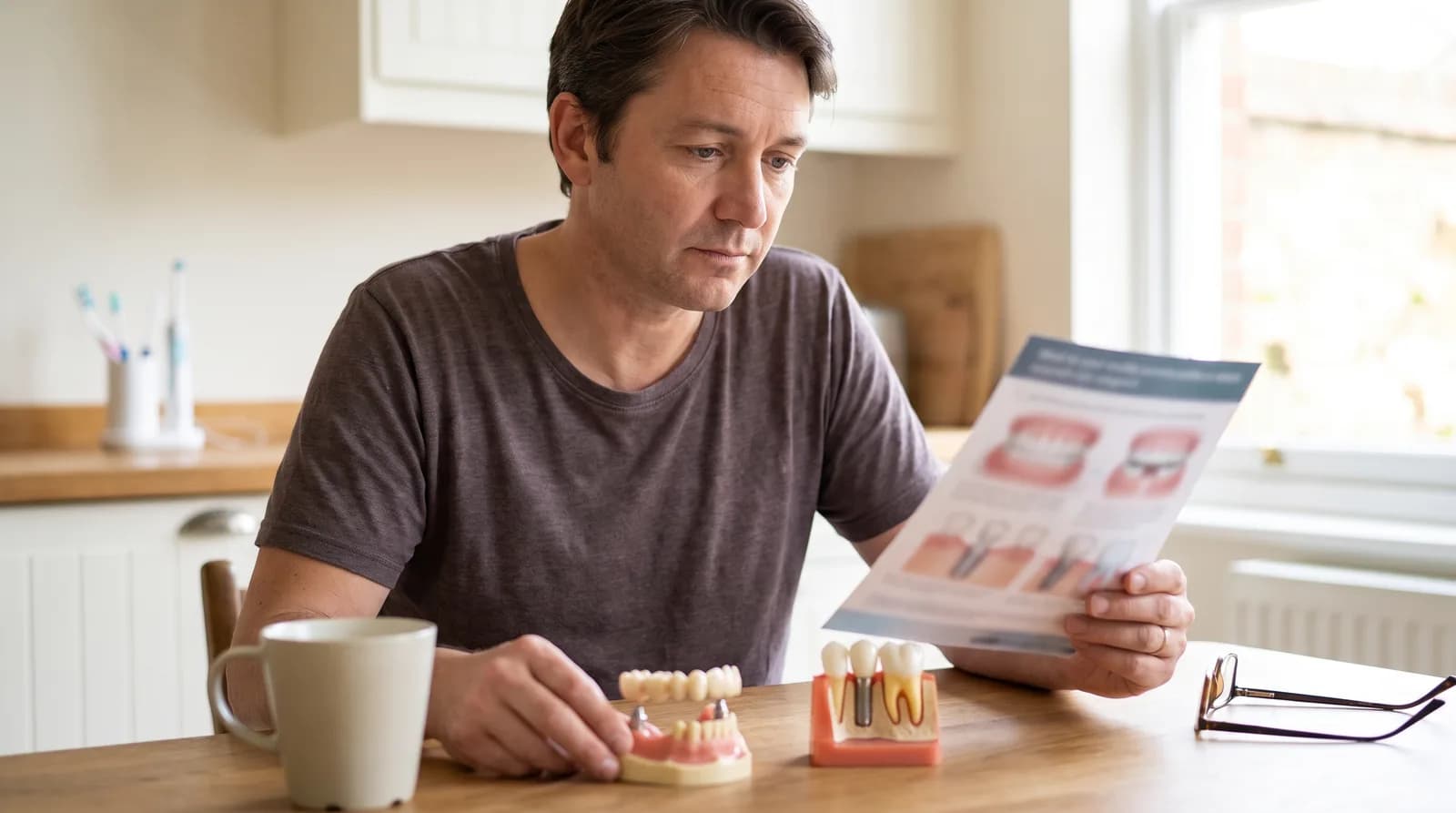
When a tooth is missing or needs to come out, patients face one of the most significant restorative decisions in dentistry: replace it with a dental implant or a bridge. Both restore function and appearance. Both are durable, well-studied restorations. But they are not interchangeable, and the right choice depends on factors specific to the patient, the missing tooth location, the health of the adjacent teeth, the jawbone, and the patient's long-term priorities. This guide compares dental implants vs bridge across the dimensions that matter most so that the conversation at the consultation can start from an informed position.
At Susan J. Curley DDS in Wall Township, NJ, Dr. Curley has placed and restored dental implants and has provided bridge restorations for years, and approaches the implant vs bridge decision as a clinical recommendation based on each patient's specific situation rather than a preference for one option over the other.
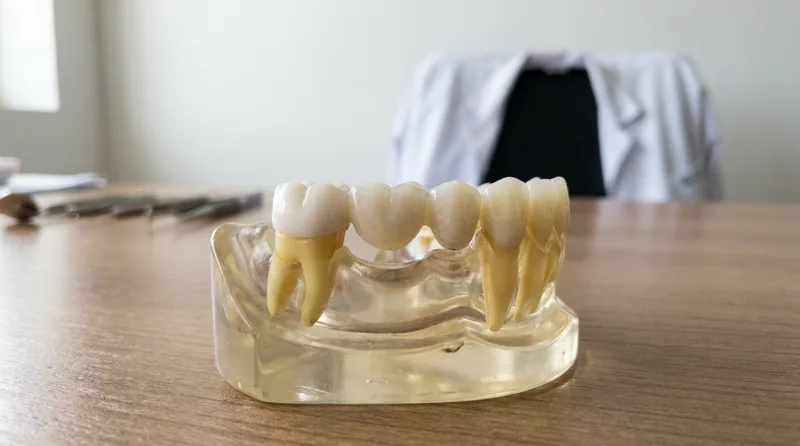
A dental bridge replaces a missing tooth by anchoring a false tooth to the natural teeth on either side of the gap. The adjacent teeth are permanently prepared to accept crowns, and the bridge is a single connected unit cemented in place. No surgery is required, and the restoration is complete in two to three weeks.
A dental bridge replaces a missing tooth by anchoring a false tooth, called a pontic, to the natural teeth on either side of the gap. The adjacent teeth are prepared by removing enamel from their surfaces to accept crowns, and the bridge is a single connected unit: two crowns flanking the pontic in the middle. The bridge is cemented in place and is not removable by the patient.
A bridge can typically be completed in two appointments over two to three weeks. The first appointment prepares the abutment teeth, takes impressions or digital scans, and places temporary crowns. The second appointment delivers and cements the permanent bridge. No surgery is involved, and no healing period is required beyond normal tissue recovery after preparation.
The trade-off is that the adjacent natural teeth are permanently altered. Enamel once removed cannot be replaced, and those teeth are now supporting a bridge for life. They also become more vulnerable to decay at the margins of the crowns and may eventually need retreatment as the bridge ages.
A dental implant replaces both the missing tooth root and the crown above it. A titanium post is surgically placed in the jawbone and integrates with the bone over three to six months. Once integrated, a crown is attached to the post, restoring full function without altering adjacent teeth.
A dental implant replaces both the missing tooth root and the crown above it. A titanium post is surgically placed into the jawbone where the tooth root once was, and over a healing period of three to six months the bone grows around and integrates with the implant in a process called osseointegration. Once integration is confirmed, an abutment and crown are attached to the implant post, completing the restoration.
An implant functions like a natural tooth root. It transfers biting force into the jawbone, which stimulates the bone to maintain its volume over time. A bridge, by contrast, spans the gap without anything in the bone beneath the pontic, allowing the bone to gradually resorb in that area over years.
According to the American Dental Association's MouthHealthy resource on dental implants, implants are designed to provide a foundation for replacement teeth that look, feel, and function like natural teeth, and the titanium post fuses with the jawbone to provide stable support that does not affect adjacent teeth.
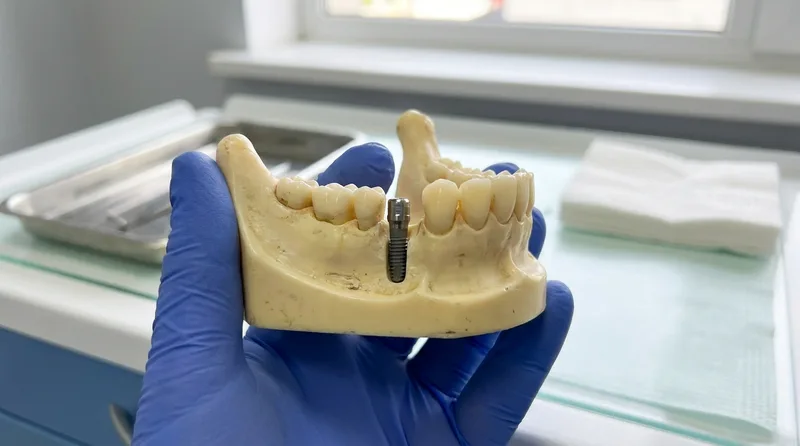
Both options close the gap, restore chewing function, and produce a natural appearance. The differences matter more over the long term than they do in the first year after placement.
| Dental Implant | Dental Bridge | |
|---|---|---|
| Treatment timeline | 3 to 9 months total | 2 to 3 weeks |
| Surgery required | Yes | No |
| Adjacent teeth affected | No | Yes, preparation of adjacent teeth required |
| Bone preservation | Yes, stimulates bone like a natural root | No, bone gradually resorbs beneath pontic |
| Longevity | 15 to 25+ years; potentially lifetime | 10 to 15 years on average |
| Flossing | Normal flossing around the implant | Requires floss threader under pontic |
| Investment level | Higher upfront | Lower upfront; replacement cost adds up over time |
| Best for | Patients with adequate bone, healthy adjacent teeth, and a long-term perspective | Patients who need faster treatment, cannot have surgery, or have adjacent teeth needing crowns already |
A dental implant is typically the superior long-term option when the adjacent teeth are healthy and do not need crowns for any other reason. Preparing those teeth for a bridge means permanently altering tooth structure that currently does not need to be altered. An implant leaves those teeth untouched while still closing the gap and restoring full function.
Bone preservation is the other significant long-term advantage. A tooth root stimulates the surrounding bone through the mechanical forces of chewing. When the root is removed and not replaced with an implant, the bone in that area gradually resorbs, changing the facial profile over years and potentially complicating future restorations if a patient eventually decides they do want an implant. Placing an implant at the time of extraction, or shortly after, prevents that bone loss from occurring.
Published research on implant outcomes has found survival rates exceeding 95% at 10 years in appropriately selected patients, with some longitudinal studies reporting rates above 90% at 20 years, according to that body of clinical evidence. For patients with adequate bone volume, no medical contraindications to surgery, and a preference for the most tooth-conservative option, an implant is typically the recommended first choice.

A bridge is the better clinical choice when adjacent teeth already have large restorations or existing crowns that need replacement regardless, when implant surgery is medically contraindicated, when bone volume is insufficient, or when the patient needs the restoration completed in weeks rather than months.
A bridge is the better choice in several specific clinical scenarios. If the adjacent teeth already have large restorations, existing crowns, or significant decay that will require crown coverage regardless, the restorative work needed for a bridge does not represent additional sacrifice of tooth structure; it consolidates work that would have been done anyway. In those situations, the bridge is clinically sensible and eliminates the need for implant surgery.
A bridge is also the appropriate choice for patients who cannot have implant surgery due to insufficient bone volume that cannot be augmented, uncontrolled systemic conditions such as uncontrolled diabetes or active autoimmune disease, medications that impair healing or osseointegration, or a patient preference to avoid surgery. The timeline advantage of a bridge, completing the restoration in weeks rather than months, is also meaningful for patients in situations where a longer healing period is not practical.
Our article on the dental implant process from consultation to crown covers what the implant timeline involves in detail for patients who want to understand what committing to an implant actually means.
Dental implants have a higher upfront investment than a bridge, and this is one of the most common reasons patients choose a bridge when an implant might otherwise be clinically preferable. The long-term financial picture is more nuanced than the initial comparison suggests.
A bridge has a typical lifespan of 10 to 15 years before it needs replacement. Each replacement involves the same clinical work and investment as the original, and the abutment teeth underneath the crowns are being re-prepared and re-crowned each time, adding wear and risk to those teeth with each cycle. An implant placed and restored correctly can last 20 to 25 years or more before any component needs attention, and the implant post itself may be permanent. When the full lifecycle cost is considered over 20 or 25 years, the two options converge significantly, and in many cases the implant represents comparable or better value than multiple bridge replacement cycles.
According to the American Dental Association, dental implants, while requiring a higher initial investment, may be more cost-effective over a lifetime compared to bridges that require periodic replacement and maintenance of the supporting teeth.
At Susan J. Curley DDS, the team provides a specific cost comparison for both options at the consultation so patients can evaluate the true long-term investment rather than only the upfront difference. Financing options are available for the implant route when the upfront amount is the primary barrier. Our article on dental insurance and what it covers explains how insurance typically applies to implants and bridges.
At a consultation at Susan J. Curley DDS, Dr. Curley evaluates the adjacent teeth, assesses bone volume, reviews the patient's medical history, and discusses timeline, priorities, and financial considerations. The recommendation is a clinical assessment of which option serves the specific patient best.
At a consultation at Susan J. Curley DDS, Dr. Curley evaluates the adjacent teeth, assesses the bone volume at the implant site with X-rays or a cone beam CT scan when needed, reviews the patient's medical history for any factors that affect implant candidacy, and discusses the patient's timeline, priorities, and financial considerations. The recommendation that follows is a genuine clinical assessment of which option serves the patient's situation best, not a preference for the higher-fee option.
To schedule an implant or bridge consultation, visit susanjcurleydds.com/book-appointment.
Missing a tooth? Start with a consultation.
Dr. Curley will evaluate your specific situation and give you a clear recommendation on whether an implant or bridge is the right choice for your tooth, your health, and your long-term goals.
View Dental ServicesReplacing a missing tooth connects to several other restorative topics covered at Susan J. Curley DDS.
Results may vary. Please consult with your dentist at Susan J. Curley DDS for personalized treatment recommendations.
Written By
Dentist
Temporary crown care tips: what to avoid eating, how to floss carefully, and what to do if it comes loose or falls off entirely.
Cost of veneers NJ: what actually drives the price, from the number of veneers to material choice and treatment planning.
Crown after root canal: why almost every treated tooth needs one, what happens if you skip it, and the right treatment timeline.
Book your visit with Dr. Curley online or call us, and we'll take it from there.