crowns
Temporary Crown Care Tips: What to Avoid Before Your Crown
Temporary crown care tips: what to avoid eating, how to floss carefully, and what to do if it comes loose or falls off entirely.
Sep 13, 20269 min read



Cost of veneers NJ searches usually come from patients who want a real answer before booking a consultation. The honest answer is that cost varies significantly. It's based on specific factors your dentist identifies at your cosmetic dentistry consultation, not a single fixed number.
Generic online ranges rarely reflect what you'd actually be quoted, since they can't account for your specific teeth, your goals, or the material that fits your case. This guide focuses on the variables that actually move the number.
Being an informed patient before your consultation doesn't require becoming an expert in cosmetic dentistry pricing. It simply means understanding the handful of factors that genuinely matter so a quote makes sense once you receive one.
Nearly all Americans, 99.7% according to the American Academy of Cosmetic Dentistry, consider their smile an important social asset. This is part of why veneers remain one of the most requested cosmetic treatments, consistent with the ADA's patient resources on veneers. This guide breaks down the actual factors behind veneer pricing in New Jersey.
Cost is driven by the number of veneers you're getting, the material chosen, whether same-day or lab fabrication is used, and how much preparation your specific teeth require. No two veneer cases combine these factors identically.
This is why two patients asking about "veneer cost" can walk away with meaningfully different numbers, even from the same practice. The variables genuinely shift the total based on your specific goals and starting point.
Understanding this upfront helps you approach a consultation with realistic expectations rather than anchoring to a single number you saw somewhere online that may not reflect what your specific case actually needs.
Geography plays a role too, since costs in New Jersey can differ from national averages due to local overhead and market factors. This is one more reason a generic online range isn't a reliable substitute for a quote based on your specific case.
Even within New Jersey, cost can vary somewhat by practice and region, which makes comparing multiple itemized quotes more useful than comparing a single number pulled from a national website.
Local overhead, lab relationships, and the specific technology a practice invests in all factor into that regional variation, none of which shows up in a generic national average pulled from a search result.
None of these factors are meant to complicate what should be a straightforward conversation. They simply explain why the number you eventually receive reflects your specific case rather than a generic figure.
Yes, a single veneer costs less than a full set, but the per-veneer cost sometimes decreases slightly as the total count increases, since planning and shade-matching are partially shared across the whole case. Most smile makeovers involve six to ten veneers on the visible front teeth.
Deciding between a single veneer and a full set often comes down to whether your concern is isolated to one tooth or affects the overall symmetry of your smile when you talk or laugh.
Patients sometimes start with a smaller number of veneers, then expand the case later once they see the results on the initial teeth. This phased approach can make the overall decision feel less overwhelming.
There's no requirement to commit to a full smile makeover in a single visit. Many patients find that starting smaller and expanding later, once they've seen and felt the results firsthand, is a genuinely comfortable way to approach cosmetic treatment.
| Factor | Porcelain | Composite |
|---|---|---|
| Relative cost | Generally higher | Generally lower |
| Durability | Excellent, often a decade or more | Good, typically shorter lifespan |
| Stain resistance | Excellent | Moderate, may need polishing over time |
| Repairability | Typically requires replacement | Can often be repaired chairside |
Yes, porcelain veneers generally cost more than composite veneers, reflecting porcelain's superior durability, stain resistance, and natural translucency. Composite veneers are a more budget-conscious option, though they typically don't last as long.
This trade-off is worth weighing against your specific priorities. A patient planning to keep their veneers for decades often finds porcelain's higher upfront cost worthwhile, while composite can suit a patient wanting a lower-commitment starting point.
Some patients also use composite veneers as a temporary or trial step before committing to porcelain, since composite can be adjusted more easily if you want to fine-tune the look before making a longer-term investment.
Our guide on the porcelain veneers process covers what to expect from this specific material in more detail. Most patients considering a long-term smile investment choose porcelain for its durability. Zirconia crowns and porcelain veneers share some of these same durability principles, though the two restorations serve different purposes on the tooth.
A veneer covers only the front visible surface of a tooth, while a crown surrounds the entire tooth structure, which is why the two are chosen for different situations even though both can involve porcelain.
Want an accurate veneer cost estimate?
A consultation gives you a real, itemized number instead of a generic online range.
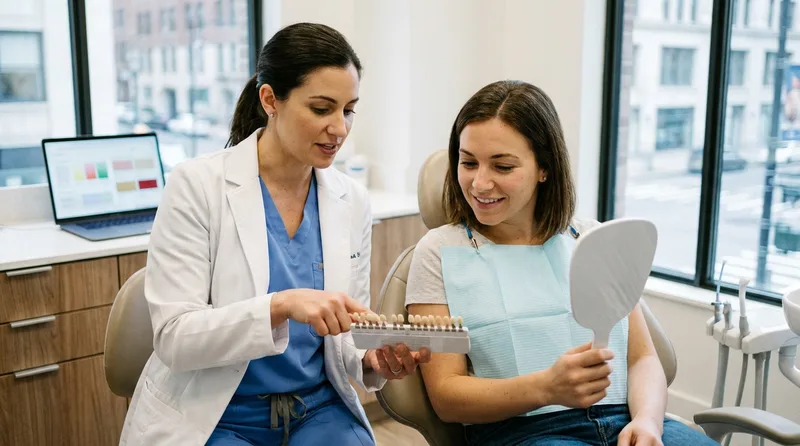
Schedule a Consultation →A digital smile design preview is often included in the overall veneer cost, since it's part of thorough treatment planning rather than a separate add-on. Our guide on digital smile design covers this planning step in detail.
This planning cost supports a predictable, well-matched final result, which is part of why skipping thorough planning to save on the front end tends to increase the risk of a result you're not fully satisfied with.
Seeing a simulated preview before committing to treatment also reduces the chance of needing adjustments after the veneers are already placed, which ultimately protects your overall investment rather than adding unnecessary cost.
Patients often find this preview step reassuring specifically because it removes the guesswork from a significant cosmetic decision. Seeing your own face with the proposed changes tends to build confidence before committing to treatment.
Yes, some veneer techniques require minimal tooth reduction while others need more substantial preparation, and the specific approach depends on your existing tooth shape, alignment, and the look you're trying to achieve. More involved preparation can affect the overall cost.
Minimal-prep veneers, when your case qualifies, tend to involve a more conservative approach that preserves more natural tooth structure, though not every smile is a candidate for this specific technique.
Patients with teeth that are already well-aligned and appropriately sized are more likely to qualify for a minimal-prep approach, while significant reshaping generally requires more substantial preparation regardless of preference.

Patients with significant misalignment sometimes benefit from completing Invisalign before veneers, which adds its own cost and timeline but can reduce how much preparation the veneers themselves ultimately require.
This sequencing decision is worth discussing openly during your consultation, since starting veneers on significantly misaligned teeth sometimes requires more aggressive reduction than would be needed after straightening first.
Generally no, since veneers are considered a cosmetic procedure rather than a medically necessary treatment, most dental insurance plans don't cover them. Some exceptions exist if a veneer also addresses a functional issue like a fracture.
Even in those exception cases, coverage is typically partial rather than complete, so confirming your specific plan's stance before treatment begins helps set accurate expectations either way.
CareCredit and Sunbit financing are available through the practice, letting you spread the cost over time regardless of insurance coverage. Many patients also phase treatment, starting with a few veneers before completing a full set.
Combining financing with a phased treatment approach gives most patients a genuinely manageable path to the smile they want, without needing to commit to the entire cost upfront in a single payment.
Discussing these options directly with the front desk before your first procedure, rather than after treatment is already underway, gives you the most flexibility in how you structure payment over time.
A short conversation at the start of treatment planning tends to save both time and stress later, since everyone involved has a clear, shared understanding of the payment approach from day one.
The only reliable way to get an accurate estimate is a consultation, since your specific number of veneers, material choice, and preparation needs determine the real number. Generic online ranges can't account for your individual case.
Bringing reference photos or a clear description of what you're hoping to achieve helps your dentist give you the most accurate possible estimate during that first visit, rather than a broad range covering every possible scenario.
This same conversation is also the right time to ask about timeline, since the number of visits and any preliminary steps like Invisalign can affect how quickly you'll see your finished result.
Ask for an itemized breakdown covering the consultation, digital smile design, and the veneers themselves, rather than a single bundled figure. This transparency helps you understand exactly what you're paying for.
A practice comfortable walking through each line item, rather than presenting one lump figure without explanation, is generally a good sign of transparency you can trust for the rest of your treatment too.
Cost of veneers NJ ultimately comes down to your specific case rather than a number you can look up in advance. Following general oral health guidance from the CDC alongside quality cosmetic treatment supports a long-lasting result. Results may vary. Please consult with your dentist at Susan J. Curley DDS for personalized treatment recommendations.
If you've been putting off a consultation because you're unsure what to expect cost-wise, an itemized estimate is the most direct way to find out.
Get a Clear Veneer Cost Estimate
Schedule a consultation with Dr. Curley in Wall Township for an itemized breakdown specific to your case.
Book Appointment →Have questions before booking?
Contact Our Wall Township Office →Written By
Dentist
Temporary crown care tips: what to avoid eating, how to floss carefully, and what to do if it comes loose or falls off entirely.
Crown after root canal: why almost every treated tooth needs one, what happens if you skip it, and the right treatment timeline.
How long do dental crowns last? Most last 10 to 15 years, depending on crown material, tooth location, and daily habits.
Book your visit with Dr. Curley online or call us, and we'll take it from there.