
Emergency Dental Care
Cracked a Tooth? A Step-by-Step Guide to What to Do Next
Cracked tooth what to do: immediate steps, types of cracks, when it is an emergency, treatment options, and same-day care at Susan J. Curley DDS.
Jul 14, 20269 min read



If you are in the middle of Invisalign treatment and your provider has mentioned attachments, or told you that refinements will be needed after your current set of trays, it is completely normal to want to understand what that means before your next appointment. These are not setbacks or signs that something went wrong. Attachments and refinements are standard tools that allow Invisalign to accomplish more complex tooth movements than the aligners alone can achieve. This article explains how Invisalign attachments explained in practical terms, what refinements involve, and why both are signs of a thorough treatment plan rather than a complication.
Invisalign attachments are small tooth-colored composite bumps bonded to specific teeth at strategic points. They create grip points that allow the aligner to exert forces on the tooth in directions that smooth aligner surfaces alone cannot achieve, enabling rotations, precise tipping, and vertical movements.
Invisalign attachments are small, tooth-colored composite bumps bonded to specific teeth at strategic points. They are typically the size and shape of a small button or rounded ridge, and when the aligner fits over them, they create additional grip points that allow the aligner to exert forces on the tooth in directions that would otherwise be difficult to achieve with smooth aligner surfaces alone.
Without attachments, an aligner can push a tooth in simple horizontal directions fairly well. But rotating a tooth around its long axis, tipping it to a precise angle, moving a single root without moving the crown, or intruding a tooth deeper into the jaw all require additional force direction that attachments enable. The attachment acts as a lever point: the aligner presses against the shaped surface of the attachment, translating the aligner's overall force into a more specific movement for that individual tooth.
Invisalign attachments are placed at the beginning of treatment or added mid-treatment when the treatment plan calls for movements that require them. They match tooth color closely and are not noticeable from a conversational distance, though they are visible upon close inspection. They are removed completely at the end of treatment, leaving no permanent marks on the tooth surface.
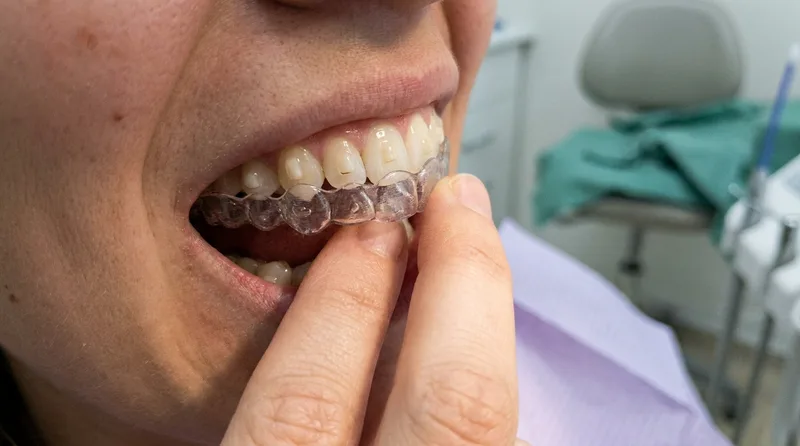
The need for attachments depends on the complexity of the required movements. Mild horizontal spacing corrections may need no attachments; significant rotation, vertical movement, or deep bite correction almost always requires them. Attachment placement is determined during the ClinCheck planning process before treatment begins.
The need for attachments depends on the complexity of the tooth movements required by the treatment plan. A patient with mild crowding involving primarily horizontal spacing corrections may complete treatment with minimal or no attachments. A patient requiring significant rotation of canines, vertical movement of teeth, or correction of a deep bite will almost certainly need attachments because those movements cannot be achieved reliably without them.
At Susan J. Curley DDS, the need for attachments is determined during the ClinCheck treatment planning process, in which Invisalign's software models the intended movement of every tooth at every stage. When the software identifies movements that require additional grip, attachments are specified in the plan. Dr. Curley reviews the ClinCheck plan with patients before treatment begins so the expected attachment locations and timing are not a surprise.
According to published research on clear aligner treatment mechanics, attachments significantly improve accuracy of complex movements including rotation and torque. A study published in a peer-reviewed orthodontic journal found that clear aligner treatment with attachments achieved clinically acceptable accuracy for over 85% of prescribed tooth movements, according to that clinical outcome data.
Attachments change the aligner fit at those sites, which many patients notice as a tighter, more secure feel. The aligners are fabricated to fit precisely over attachments, so this is intentional. Attachments are tooth-colored and blend closely with natural enamel but may catch light under bright overhead lighting.
Attachments change the fit of the aligner over the teeth with the attachments, which some patients initially notice as a tighter or more secure feeling at those sites. The aligners are fabricated to fit precisely over the attachments, so the fit is intentional rather than a sign that something is wrong. Many patients find that aligners with attachments feel more secure and stay in place more reliably than aligners without them.
The visibility of attachments depends on their location and size. Attachments on the front teeth are more visible than those on the premolars or molars, though the tooth-colored composite material means they blend with the natural tooth color in most cases. Under some lighting conditions, particularly very bright or overhead lighting, attachments may catch the light and be slightly more noticeable. Patients who are concerned about visibility should discuss attachment location with Dr. Curley during the planning phase, as some flexibility exists in where certain attachments are placed.
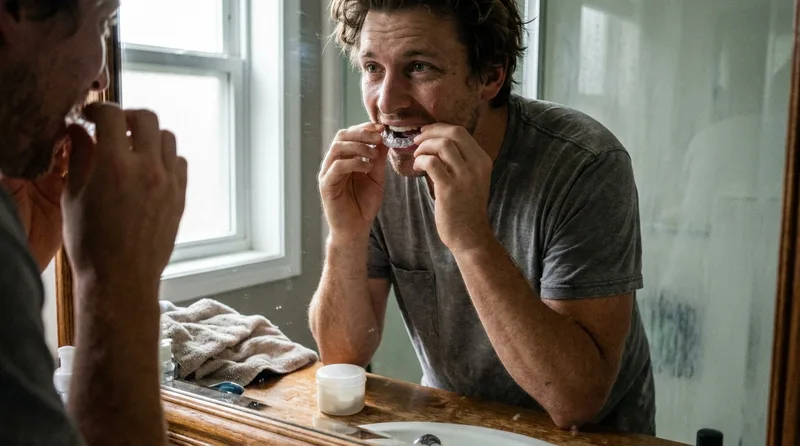
Refinements are additional sets of aligners ordered after the initial set of trays has been completed. They address any tooth movements that did not fully achieve their planned position during the original course of treatment, or they extend the treatment to accomplish movements that were not fully accounted for in the original plan.
Refinements are extremely common and should not be interpreted as a failure of the original treatment. Clear aligner treatment involves complex biomechanics across many teeth simultaneously, and individual biological variation in how teeth respond to force means that actual tooth position at the end of the original tray series is rarely an exact match to the predicted virtual position from the initial planning. Refinements correct this gap.
The refinement process begins with new scans or impressions of the teeth in their current position after completing the original aligner series. These are submitted to Invisalign, which generates a new ClinCheck plan showing the additional movements needed and produces a new set of aligners. The refinement set typically involves fewer trays than the original series, since only a subset of teeth usually need further correction.
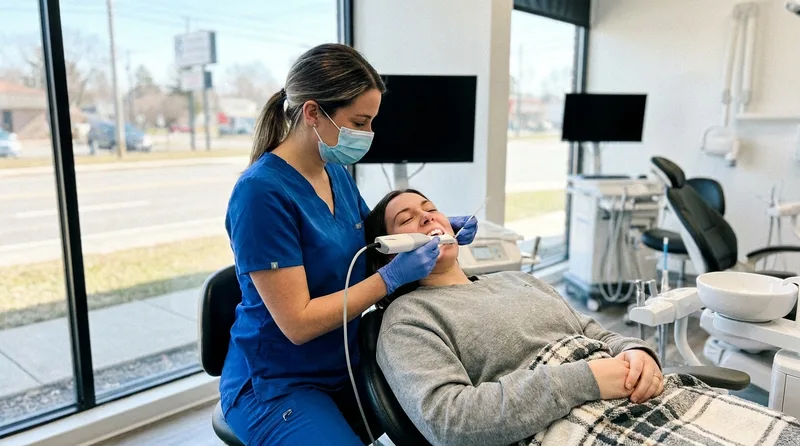
Most patients require one round of refinements. Complex cases or those with inconsistent wear compliance may require two or more. The number cannot be predicted with certainty before treatment because it depends on how each patient's teeth respond to aligner forces over the course of treatment.
Most patients require one round of refinements. Some require two or occasionally more, particularly for complex cases or cases where treatment compliance was inconsistent during the original series. The number of refinements needed is not a fixed prediction that can be made with certainty before treatment begins, because it depends on how each individual patient's teeth respond to the aligner forces over the course of treatment.
A patient who wore their aligners for the recommended 20 to 22 hours per day consistently and changed trays on schedule is more likely to achieve close to their planned tooth position and require minimal or no refinements than a patient who wore aligners inconsistently. Compliance is the single factor most within the patient's control that affects how much refinement work is needed.
According to the American Dental Association, studies show that patients who wear Invisalign aligners for the recommended 20 to 22 hours per day achieve their planned tooth positions approximately 30% more accurately than those who wear them fewer than 18 hours per day, according to published compliance and outcome data. Clear aligner treatment outcomes depend significantly on patient compliance with wear time, and inconsistent wear is one of the most common reasons additional aligner stages are required to achieve planned tooth positions.
A refinement appointment begins with new digital scans using the iTero scanner to capture current tooth positions. These are sent to Invisalign for refinement planning, Dr. Curley reviews and approves the proposed plan, and the new aligners are ordered. Any attachment adjustments are made when the refinement aligners are delivered.
A refinement appointment at Susan J. Curley DDS begins with new digital scans using the iTero scanner. The scans capture the current tooth positions precisely and are sent to Invisalign for refinement planning. Dr. Curley reviews the proposed refinement plan, may make adjustments, and approves it before the new aligners are ordered. When the refinement aligners arrive, they are delivered at a second appointment at which any necessary attachment adjustments are also made.
The iTero scanner used at Susan J. Curley DDS eliminates the need for traditional impressions at the refinement stage, making the process faster and more comfortable than older scanning methods. Our article on iTero 3D scanning covers how digital impressions work and why they are more accurate than traditional trays for aligner fabrication. To ask questions about your Invisalign treatment or to schedule a refinement scan, visit susanjcurleydds.com/book-appointment.
Questions about your Invisalign treatment?
Dr. Curley walks through every stage of treatment with Invisalign patients at Susan J. Curley DDS in Wall Township, NJ, including what to expect if attachments or refinements are part of your plan.
Invisalign ServicesInvisalign attachments and refinements are part of the broader Invisalign treatment picture at Susan J. Curley DDS.
Results may vary. Please consult with your dentist at Susan J. Curley DDS for personalized treatment recommendations.
Written By
Dentist
Cracked tooth what to do: immediate steps, types of cracks, when it is an emergency, treatment options, and same-day care at Susan J. Curley DDS.
Dental anxiety tips from Susan J. Curley DDS: judgment-free care, sedation options, what to expect after a long absence, and how to make your first call.
Full mouth restoration dentistry at Susan J. Curley DDS: who needs it, what it involves, why Pankey and Dawson training matters, and how to start.
Book your visit with Dr. Curley online or call us, and we'll take it from there.